


The only thing that can overpower prospect theory is the immeasurable power of the human soul, obviously
Losing makes you want to win it back; winning makes you want to grab profit fast. Natsuki, who can't stop slamming high lots, uses prospect theory and prop firm rules to ask traders around the world for a little empathy.
Hello everyone, and hello again!
NATSUKI here, the man who wants his heart to stay in eternal summer, even in winter. It's November, and even my heart's eternal summer is starting to ask for a heater. It got cold out of nowhere, man.
So.
Today, let me start with a confession. Because I llllove you! Love injection.
This Natsuki gets swept up in his emotions, thinks
"Whatever, I don't care what happens anymore,"
and slams in a high lot. A bottom-tier trader.
Yep. I said it. I actually said it. Ugh, now I'm depressed.
Well, sometimes it worked out: I clawed back the loss and, for a while, ended up with a pretty decent profit. Around ¥800,000 on a single trade.
That has happened.
It has.
But,
somewhere along the way, I always end up losing.
Natsuki when winning: "I might be a genius." Natsuki when losing: "The genius is closed for business. Nighty-night."
The business hours were too short. Too soon… it's rotten.
And then it hit me.
Isn't this the same for every trader in the world?
So what is prospect theory, anyway?
Serious mode, just for this part. I straighten my back so hard I go from 180 cm to 185 cm.
Prospect theory was published in 1979 by psychologists Daniel Kahneman and Amos Tversky. It explains how people feel about gains and losses, and how that shapes their choices. Kahneman received the Nobel Memorial Prize in Economic Sciences in 2002, partly for this work.
Roughly, it goes like this.
① For the same amount, a loss hurts more than a gain feels good (loss aversion). Later research produced a famous estimate: the pain of a loss is about twice the joy of a gain.
② When you're in profit, you want the sure thing. Offered "a sure ¥50,000" or "a 50% chance of ¥100,000 and a 50% chance of nothing," most people take the sure ¥50,000.
③ When you're in a loss, you want to gamble. Offered "a sure loss of ¥50,000" or "a 50% chance of losing ¥100,000 and a 50% chance of losing nothing," most people now pick the gamble.
……
③.
It's ③.
That's basically Natsuki's high lot.
The moment I'm sitting on an open loss, accepting a sure loss hurts too much, so:
"If I double down here, maybe it all goes back to zero."
"There's no reason. But I have to do it here… I have to!"
"GO FOR IIIIIIIIIIIIT!"
Full-on anime brain. Thank you very much, truly.
And then I get sucked through the 50% door.
And I do ② too. Win a little, and I want to take profit right away.
The result: small profits, big losses.
The exact opposite of "cut losses short, let profits run." Flipped perfectly. In Othello, they'd have taken my corners too.
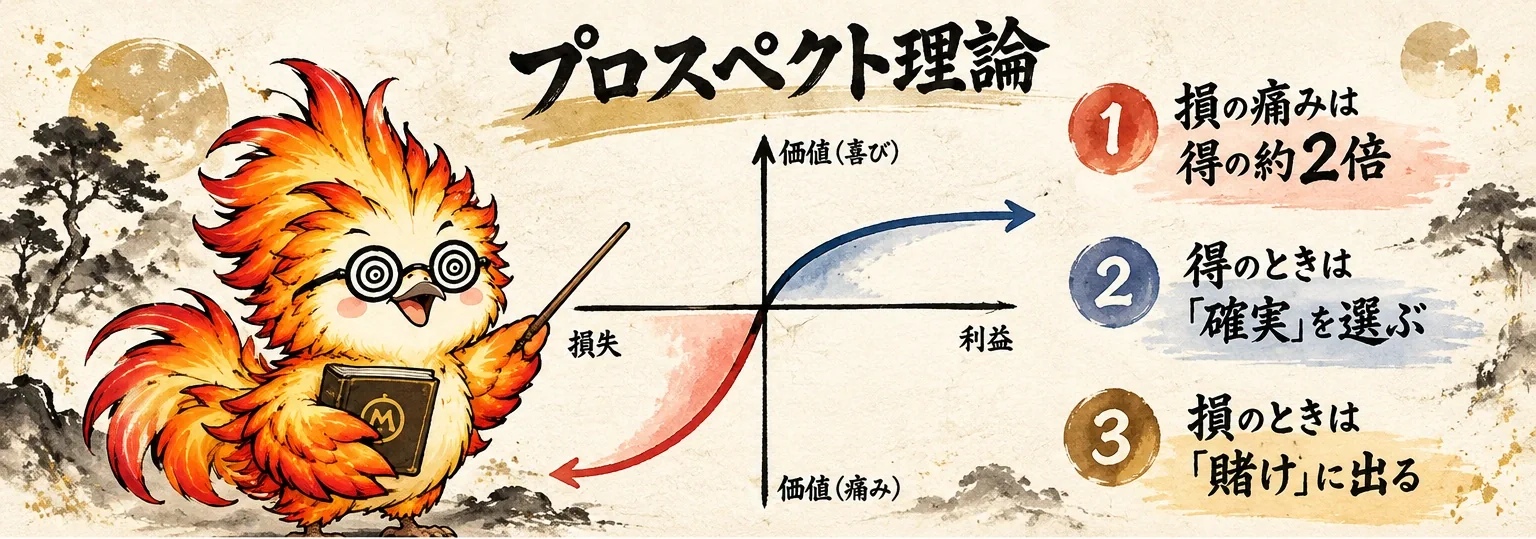
Same for every trader? → Pretty much, yes
"Isn't that just Natsuki's personality, though?"
If you thought that,
you're half right. The other half, leave me alone.
Loss aversion has been studied all over the world. A survey covering people in 53 countries also reported that, while the strength varied, people in every country tended to weigh losses more heavily.
In other words,
the trader in London, the trader in São Paulo, the trader in Istanbul,
all stare at their open losses and pray somewhere deep inside,
"Come back… come back to me… you'll come back, right? Please come back."
Somewhere in the world, right this second.
Doesn't it suddenly feel like you have a lot more friends?
Natsuki felt it. Natsuki felt saved.
So I have a favor to ask.
Please relate to me.
Just "I get it" is enough. "Natsuki, same here" is enough. "I don't do that, but I understand the feeling" — I'll accept that too, barely.
That alone will improve the quality of Natsuki's sleep tonight.
Honestly, the only thing that can overpower prospect theory is the immeasurable power of the human soul, obviously
Now, about the title.
A Nobel-level theory explains that "humans end up acting like this."
So what does it take to beat that?
Knowing the theory? I know it. I just wrote it.
Reading books? I read them. That's a lie, I didn't.
And yet, faced with an open loss, Natsuki's finger goes to the lot size field and adds zeros on its own.
I've repeated this thousands of times. If I could have repeated not repeating it, I honestly think I'd be a billionaire by now. That's how confident I am in my winning points. I even build a signal tool called Atelier, and still there's a Natsuki who doesn't follow the signals.
Somehow, I can't. No matter what, I can't.
Why?
Because Natsuki's emotional fire burns too strong. When I lose, I flare up. "Whatever, I don't care what happens anymore" — the void kicks in. I think it's a strong habit from times in my life when things were hard and I gave up on myself. Karma, basically. Fire element mixed with dark element. A nasty combo. I burn while I suffer. Could someone cast water and light on me?
I think a pure fire, like a phoenix's, would be fine… a fire that burns without being hot. That's the kind of fire I want.
Well, if anything can overpower those negative emotions,
it has to be the immeasurable power of the human soul, obviously.
…That's what I think. I think we have no choice but to carry the phoenix's sacred flame.
When human nature comes to the surface and the soul's true nature hides
I want to believe in the power of the soul. But there are times when it can't come out.
To bring it out fully, you need to be in a state where "greed" doesn't show up, right? The more greed you show, the more you lose. I believe that's a truth.
Natsuki feels that greed comes from the karma, or the DNA, living in this body — the human part, not the soul.
But sometimes I just can't… there are moments I can't resist. When karma or DNA or whatever goes out of control, I want something that stops it. When the fire gets too strong, you want the power of water. That kind of story. Spiritual Trading Theory. What is that even.
This is where prop firm rules play an interesting role, right?
On your own-money account, nobody stops you when you hit a high lot. As long as the account survives, the soul can floor the accelerator again and again.
A prop account comes with loss limits set from the start.
For example, MONETA's Phoenix:
・Daily loss: up to 3% of the account size at your current level ・Maximum loss: 6% (static) ・On Funded accounts, a warning when the floating loss on the same symbol reaches 2%. All positions are closed automatically, a 1.5% limit per trade idea applies after that, and breaking it is a breach
On some accounts, such as 1-Step, you breach the moment your floating loss reaches 1%. (In November 2026, Instant changed to a warning at 2%.)
So if you go "whatever, I don't care what happens anymore" in a prop account,
something really does happen. In the form of a breach.
These rules may look cold.
But if ③, "wanting to gamble when you're in a loss," is human nature, you could also call them a system that decides in advance how far you're allowed to gamble.
When the clear soul has hidden and your human blood is boiling over, someone beside you says,
"Okay, that's enough~"
In that moment you'll probably feel a ton of frustration, but you need to take it honestly as a sign that you must not go any further.
I remember blowing up an account, buying a new one, and basically doing an averaging-down challenge. At the time, I just couldn't fully accept that things were "bad."
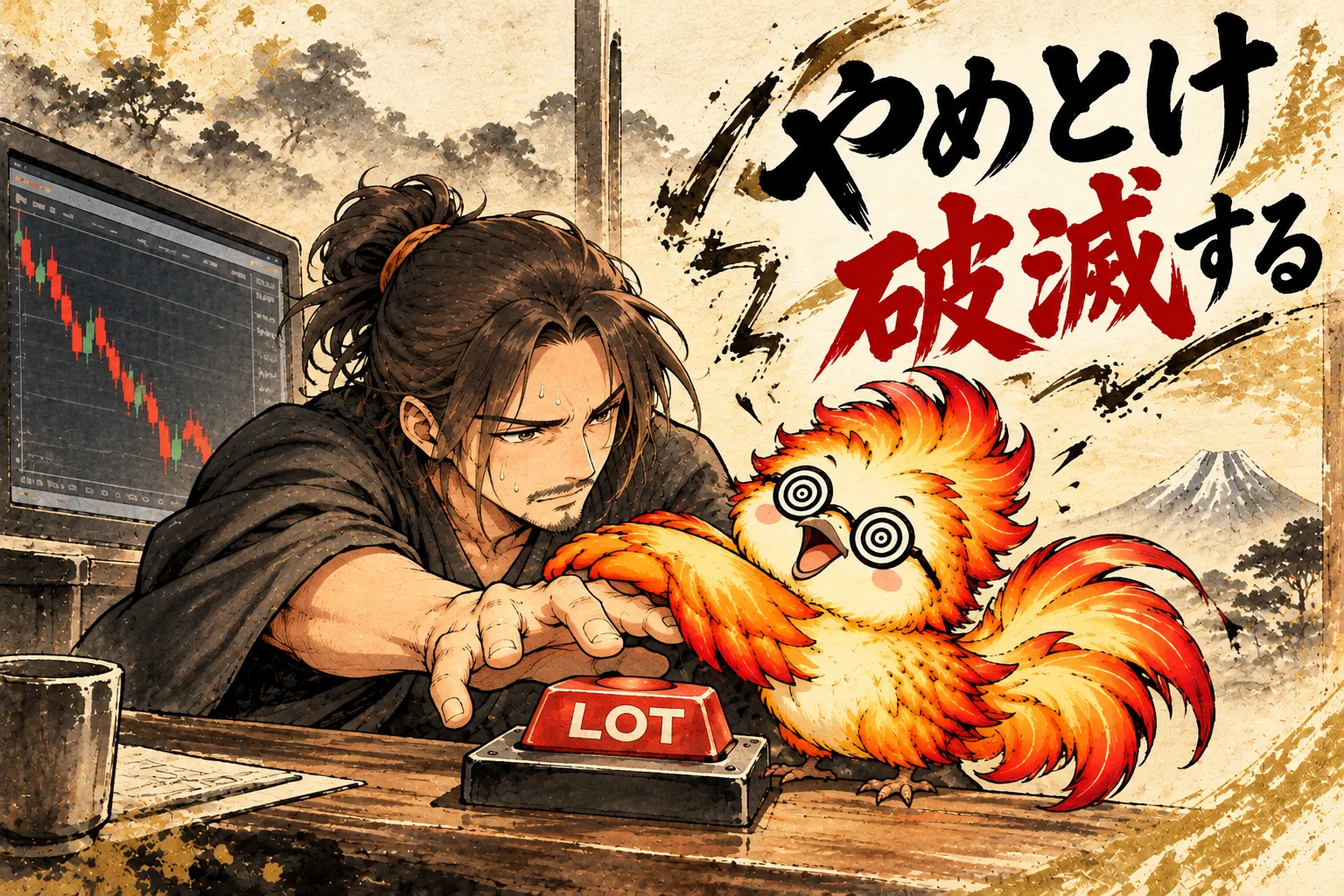
When the soul's power hides
I'm talking as if that power exists, but,
the heat you bring to the chart, the grit to sit back down in front of the screen after a loss, the dream of winning big someday:
I think that's essential fuel for keeping on trading.
But when you mistakenly pour that fuel onto the fire of emotion,
when you're building, with your own hands, the moment your dreams come crashing down,
first,
Using it to raise your lot in the middle of an open loss. That's exactly what prospect theory expects. Exactly what karma expects.
Let's stop. I want to stop. Let's stop.
Using it to decide your lot and stop loss before you enter. Using it to keep the rules you set while your emotions are screaming.
If you could put all your passion's fire into those, I feel like you could say you've overpowered the theory.
I only feel like you could say it. Natsuki hasn't overpowered it yet.
When I do, I'll write about it. If I lose in a way I shouldn't, I'll probably confess again.
Either way it turns into an article. That's kind of cheating, huh!
Finally, to struggling traders around the world
Natsuki is bottom-tier. I do have a strong fortune-teller side where the points I call actually hit quite a lot, but I'm the guy who keeps doing unnecessary things, so: bottom-tier.
But I've come far enough to admit I'm bottom-tier, put it into writing, and say,
"Isn't everyone like this?"
I wrote this article hoping I can overpower that human part and keep making choices that let the soul's true nature come to the surface.
Maybe you, reading this to the end,
have had at least one night
when you pressed the
"whatever, I don't care what happens anymore"
button.
It's not true that whatever happens is fine.
But if there was a moment you pressed that button, welcome. This is a place for people who know the same night.
Please relate to me. And next night, let's decide our lot size together before we go to sleep.
Let's trade only at the points we decided.
For now, let's just do that.
Do it, and you'll win. Probably.
It's okay, a high lot once in a while. But I think that's only when your own theory is telling you with certainty, "Strike here." If you can't limit it to that, you shouldn't do it. Also, one reason you tend to lose after winning with a high lot: the dopamine from the win tends to rule the time that follows. If you can't control that, you shouldn't do it.
So, basically, it's more stable not to do it. Keep the ingredients of instability as far away from you as you can.
Come to think of it, when I was growing my own money steadily, I had other things I wanted to do and treated it like savings. But then something stressful happened in my private life, and to drown out the stress I slammed a high lot one day, lost, and kept on destroying things after that…
The battle with greed is nothing other than a dialogue with your own soul… so what I'm trying to say is, it's a little bit spiritual and occult, you know. Come to think of it, a friend who got good at mahjong said it started after he began believing in the occult and feng shui…
Maybe believing in things you can't see matters too — and on that note, I'll wrap up.
Full bellies, full dreams — I'll see you again on the other side of probability. Thank you, thank you.
लेखक: Natsuki